

What Is the Correct Distance Between a Synthetic Eyelash and the Eyelid?
10th Jan 2026
The correct distance between a synthetic eyelash and the eyelid margin is one of the key elements of a professional lash application. It affects not only the appearance of the lash line, but above all the wearing comfort, retention, and the health of the client’s natural lashes.
An incorrectly chosen distance may cause discomfort, premature lash loss, or a visible regrowth effect on the very first day after application.

In this article, you will learn:
➤ What is the correct distance between a synthetic eyelash and the eyelid
➤ The consequences of attaching lashes too close or too far from the eyelid
➤ How to visually assess the correct distance in practice
The Ideal Distance – Theory vs. Practice
According to theory and training standards, the correct distance between a synthetic eyelash and the eyelid margin should be approximately 0.2–0.5 mm.
In practice, however, numbers are less important than following a few essential rules:
-
the synthetic lash must not touch the skin,
-
it should not create a visible gap or a “grown-out” effect on the first day,
-
the entire lash line should maintain a uniform distance from the eyelid.
The distance should always be adapted to the client’s eye anatomy. With deep-set eyes, hooded lids, or strongly curved natural lashes, the visual perception may differ slightly—but comfort and safety remain non-negotiable.
Effects of Attaching Synthetic Lashes Too Close to the Eyelid
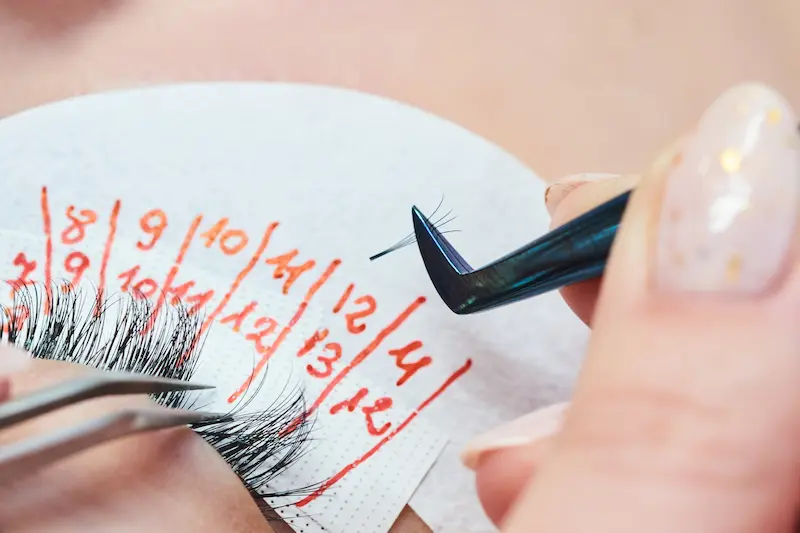
Attaching a synthetic lash too close to the eyelid margin may initially appear aesthetically pleasing. The synthetic lash lifts the natural lash and creates a strong, defined lash line. Unfortunately, this effect is misleading. In practice, such application can lead to serious health- and comfort-related consequences.
The most common effects of attaching lashes too close include:
-
Discomfort and stinging of the eyelid – the lash rubs against the skin with every blink, causing burning, irritation, and constant eye discomfort.
-
Blockage of the glands responsible for the tear film – this may result in dry eye syndrome, a gritty “sand in the eyes” sensation, and chronic irritation.
-
Increased risk of allergic reactions – when adhesive comes into contact with the skin, the likelihood of redness, swelling, and itching rises significantly.
-
Damage to baby lashes – a synthetic lash placed too close can bond with newly growing natural lashes, leading to their being pulled out during growth or removal and weakening the natural lash line.
Effects of Attaching Synthetic Lashes Too Far from the Eyelid
Placing a synthetic lash too far from the eyelid margin is also not a solution. While it eliminates the risk of stinging and skin irritation, it creates other problems—mainly related to aesthetics and retention.
The most common consequences of attaching lashes too far include:
-
A grown-out appearance from day one – the lash set looks as though it was applied at least a week earlier.
-
Reduced retention – the adhesive lacks an optimal bonding surface, causing the extensions to detach and fall out more quickly.
-
An uneven lash line – visible gaps, misaligned lashes, and a lack of overall harmony in the set.
Excessive distance is primarily an aesthetic and longevity issue. Clients tend to notice it quickly, which can lead to dissatisfaction, complaints, and a loss of trust in the stylist.
How to Visually Assess the Correct Distance
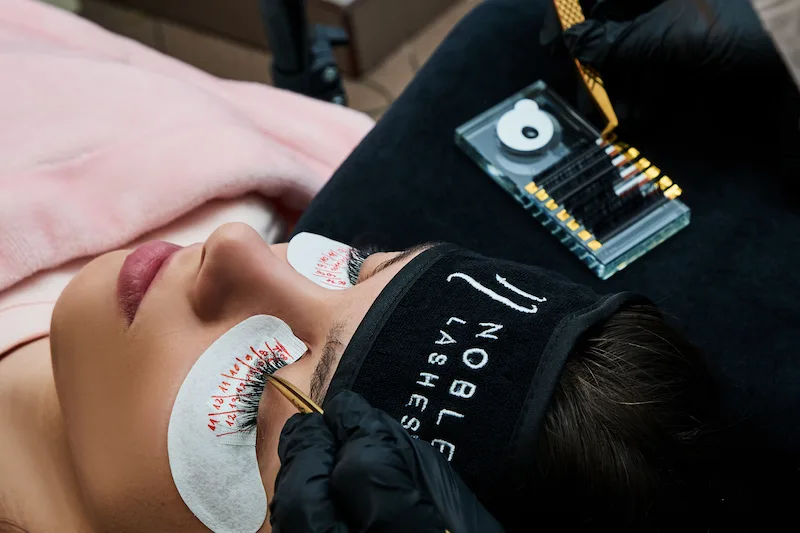
From the stylist’s perspective, when the client is lying on the treatment bed, you can see three key elements:
-
the eyelid margin,
-
the natural lashes growing from it,
-
the point where the natural lash emerges from the eyelid and its length begins.
The synthetic lash should be attached just above the point where the natural lash emerges, leaving a minimal buffer that is invisible to the naked eye.
Warning signs:
-
if the synthetic lash touches the skin – it is too close,
-
if there is a clearly visible gap – it is too far away.
The most important factor is consistency. Each synthetic lash should be attached at a similar distance to create a smooth, harmonious lash line and a professional final result.
The Most Common Mistake Lash Stylists Make
Many stylists focus too much on “perfect millimeters” and forget to evaluate the overall visual effect.
Tip: Instead of obsessively measuring distance, look at the entire set.
No stinging, no irritation, and no visible regrowth on the day of application are the best indicators that the distance is correct.
Correct Distance – A Skill Built Through Practice
Although the 0.2–0.5 mm range is technically correct, these values can be difficult to visualize in daily work. Lash styling is done on a micro scale, and every millimeter looks different depending on:
-
the thickness of the synthetic lash,
-
the length of the set,
-
the direction of natural lash growth.
That’s why, alongside theory, developing a trained eye is essential. Learning correct distance happens under the lamp, on real eyes—not only through diagrams or written descriptions.